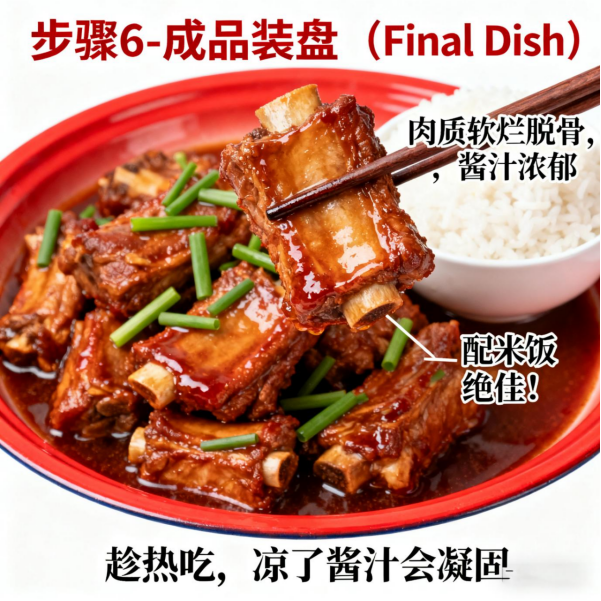


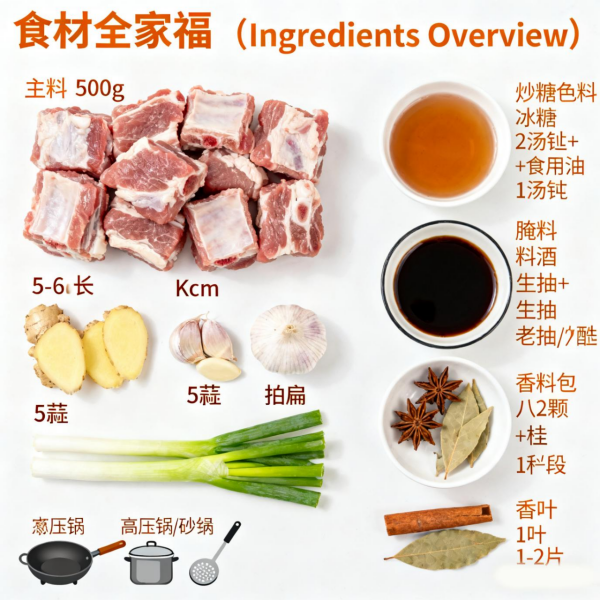
This is a national – level classic home – style hearty dish. The pork ribs are coated in a bright red, rich sauce. With one bite, the meat is tender but not tough, savory with a hint of sweetness, and even the gaps between the bones are filled with flavor. It’s so delicious that you can eat an extra two bowls of rice with it! The cooking method isn’t too complicated; mastering the caramelization of sugar and the stewing time is the key to success.
1. Ingredients (Serves 2 – 3)
Main Ingredients:
- 500 grams of pork spare ribs (Choose spare ribs with bones and meat, as the meat is the most tender; avoid spine bones, which have little meat and are tough. Frozen spare ribs need to be thawed in advance and soaked in clean water for 1 hour to remove blood.)
- 1 piece of ginger (Sliced, about 5 – 6 slices, essential for removing fishy odors)
- 5 cloves of garlic (Smashed, to enhance aroma; reduce to 2 cloves if you don’t like garlic)
- 3 green onions (Cut into sections, separate the white and green parts. The green parts are sprinkled at the end to boost the aroma)
Seasonings (Spices can be adjusted flexibly; the core is caramelizing sugar):
- 2 tablespoons of rock sugar (Used for caramelizing sugar, which gives a brighter color than white sugar. If there’s no rock sugar, replace it with 1.5 tablespoons of white sugar)
- 1 tablespoon of cooking oil (Used for caramelizing sugar and stir – frying spices)
- 2 tablespoons of cooking wine (For removing fishy odors; beer or rice wine can be used as substitutes for a richer flavor)
- 2 tablespoons of light soy sauce (Enhances freshness and saltiness, a basic seasoning)
- 1 teaspoon of dark soy sauce (Used in small amounts for coloring to make the sauce reddish – brown; adding too much will make it bitter)
- 2 star anise (Enhances aroma; can be omitted if unavailable, but the aroma will be reduced)
- 1 small section of cinnamon (About 5 cm, enhances aroma; if unavailable, replace with 1/2 teaspoon of thirteen – spice powder)
- 1 – 2 bay leaves (Enhances aroma; don’t use too many, as it may cause a astringent taste)
- 1000 milliliters of water (Or an amount that covers the spare ribs, used for stewing)
- 1/4 teaspoon of salt (Used for final seasoning; don’t add it early to avoid making the meat tough)
2. Required Tools
- Wok (Used for caramelizing sugar and stir – frying spices; a deeper wok prevents oil splatters)
- Pressure cooker (Optional, saves time for stewing, and the ribs can become tender in 30 minutes. If not available, use a regular wok or clay pot, and extend the stewing time to 1.5 hours)
- Slotted spoon (Convenient for fishing out blanched ribs and draining water)
- Small bowl (Used for holding spices for easy access)
- Paper towels (For dabbing moisture from the surface of the ribs to prevent oil splatters when stir – frying)
- Spatula (Silicone or wooden spatula, to avoid scratching the pot when caramelizing sugar)
3. Detailed Steps
Step 1: Preprocess the Ribs (Remove Blood and Fishy Odor, Make the Meat Tender)
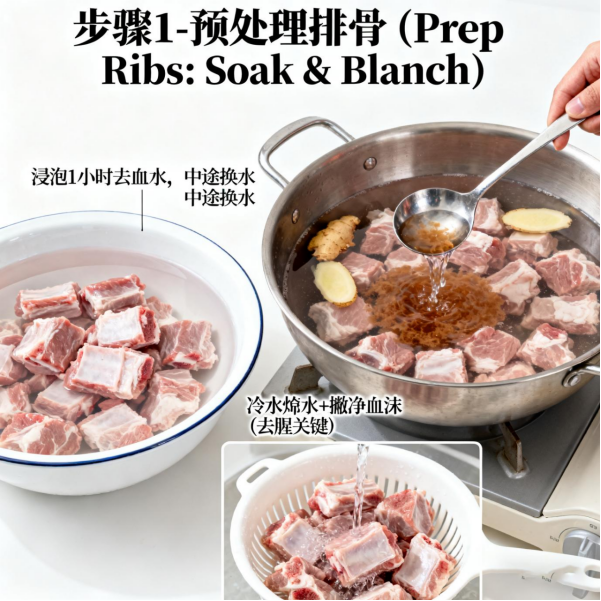
- Soak to remove blood: Cut the spare ribs into 5 – centimeter sections (you can ask the seller to cut them when buying). Put them in a basin, add enough clean water to cover the ribs, and soak for 1 hour (change the water 2 – 3 times halfway to soak out the blood and reduce the fishy odor. Frozen spare ribs need to be soaked for an extra 30 minutes).
- Blanch in cold water: Take out the soaked ribs, put them in a pot, add enough cold water (to cover the ribs), 2 slices of ginger, and 1 tablespoon of cooking wine. Turn on high heat to boil.
- Skim off the foam: When the water boils, gray foam (the main source of the fishy odor) will float on the surface. Use a spoon to skim it off completely (don’t leave any, otherwise the stew will have a fishy smell). Then continue boiling for 1 minute, take out the ribs, rinse them with warm water (don’t use cold water, as the temperature difference will make the meat tight), and drain the water for later use.
Step 2: Caramelize Sugar (The Core of Coloring! Don’t Burn It)
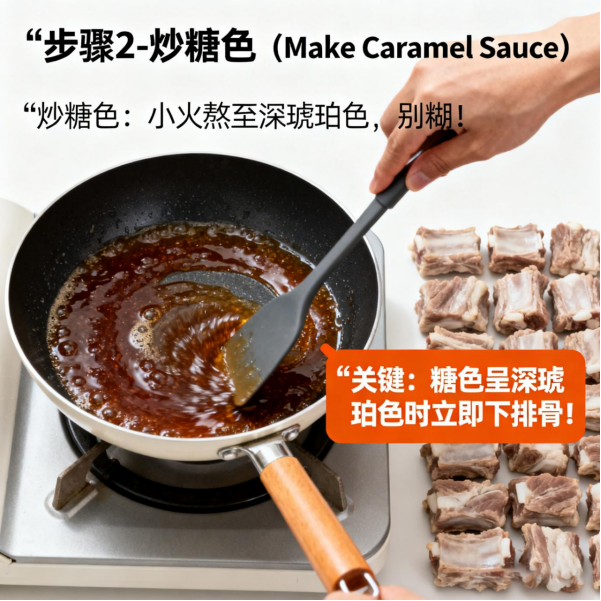
“Caramelization: Simmer over low heat until it turns dark amber; don’t burn it!
“Key point: Add the ribs immediately when the caramel turns dark amber!
- Heat the wok over low heat, pour in 1 tablespoon of cooking oil. When the oil is hot (you can feel slight heat when putting your hand above the wok), add the rock sugar. Gently stir with a spatula to ensure the rock sugar is evenly heated.
- Keep stirring over low heat until the rock sugar is completely melted. The color will change from transparent to light yellow, then to dark amber (Note: Never wait until it turns black, as it will burn! Burnt caramel tastes bitter and will ruin the entire dish. Proceed to the next step as soon as you see dark amber).
Step 3: Stir – Fry Ribs + Stir – Fry Spices (Enhance Aroma and Flavor)
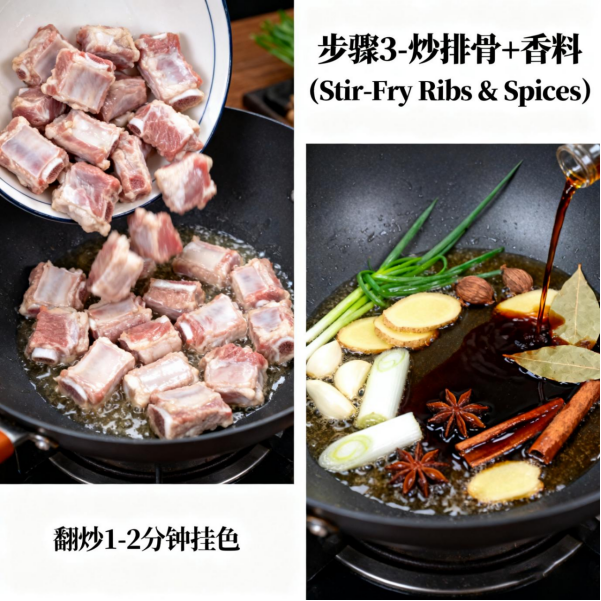
- Keep the heat on low, pour the blanched ribs into the wok with the caramel. Stir – fry quickly for 1 – 2 minutes to ensure each piece of rib is evenly coated with the caramel (at this point, the ribs will take on a beautiful light red color).
- Add the ginger slices, smashed garlic, white parts of the green onions, star anise, cinnamon, and bay leaves. Continue stir – frying for 30 seconds until you smell the aroma of the spices (don’t stir – fry for too long, as the garlic is easy to burn).
- Drizzle 1 tablespoon of cooking wine along the edge of the wok, stir – fry for 10 seconds, and use the steam from the cooking wine to remove any remaining fishy odor.
- Add the light soy sauce and dark soy sauce, stir – fry quickly and evenly to coat the ribs with the sauce (don’t add too much dark soy sauce, and don’t stir – fry slowly, otherwise it’s easy to stick to the bottom of the wok).
Step 4: Stew (The Key to Tender Ribs That Fall Off the Bone!)
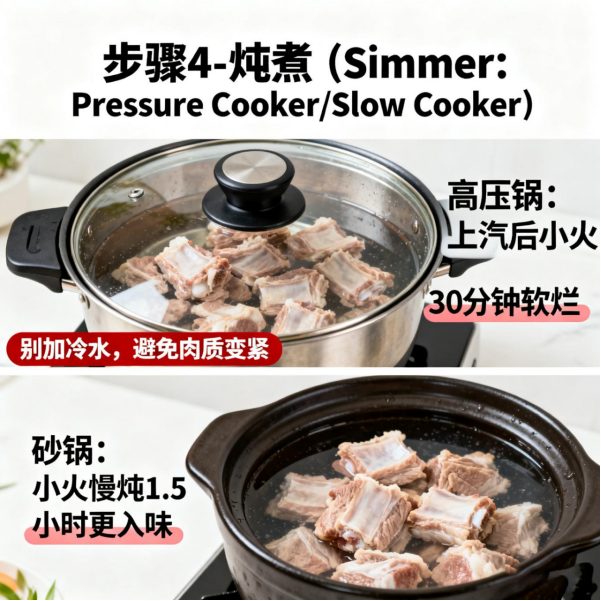
Method 1: Pressure Cooker Version (Time – Saving, Suitable for Beginners)
- Pour the stir – fried ribs and all seasonings into the pressure cooker, add enough water (to cover the ribs by 2 cm; don’t add too little, otherwise it will dry out during stewing).
- Close the lid of the pressure cooker, heat over high heat until the safety valve starts to release steam. Then turn to low heat and stew for 30 minutes (don’t shorten the time, otherwise the meat won’t be tender).
- Turn off the heat and wait for the pressure cooker to release pressure naturally (don’t force open the lid, it’s dangerous). Then open the lid and pour the ribs back into the wok if there’s too much soup.
Method 2: Wok / Clay Pot Version (Traditional Method, Richer Aroma)
- After stir – frying the ribs, directly add enough water to the wok (to cover the ribs by 2 cm). Bring to a boil over high heat, then turn to low heat, cover the pot, and simmer for 1.5 hours (a clay pot has good heat retention, so the time can be shortened to 1 hour).
- Don’t open the lid frequently during stewing to avoid losing aroma and excessive evaporation of the soup. If the soup is too little, add a small amount of hot water (don’t add cold water).
Step 5: Thickening the Sauce + Seasoning (The Sauce Tastes Best When It Clings to the Ribs)
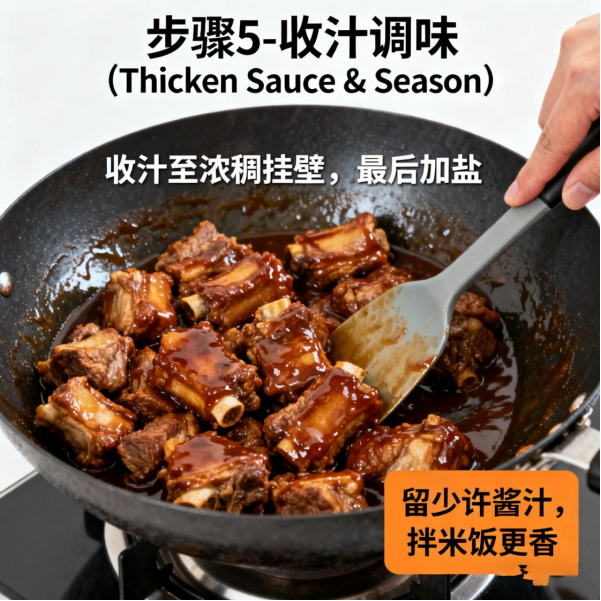
- No matter which stewing method you use, finally turn to high heat to thicken the sauce: Gently stir the ribs with a spatula to ensure each rib is evenly coated with the sauce while evaporating excess water.
- Taste the sauce. If it’s too bland, add 1/4 teaspoon of salt (don’t add too much, as the light soy sauce is already salty). Stir well.
- How thick should the sauce be? You’ll know it’s ready when the sauce becomes thick. When you lift the spatula, the sauce should cling to it without dripping, or when it drips, it forms small pools in the wok (don’t thicken it too much; leave a little sauce, as it’s perfect for mixing with rice).
- Turn off the heat, sprinkle the green parts of the green onions, cover and let it sit for 1 minute to blend the flavors. Then transfer it to a plate and serve hot!
4. Tips for Success
- No fishy odor in ribs: Be sure to soak to remove blood + blanch in cold water and skim off the foam. Neither step can be skipped. Using cooking wine / beer can further remove the fishy odor.
- No burnt caramel: Keep the heat on low throughout the process, keep an eye on the color change of the rock sugar, and add the ribs when it turns dark amber. If you’re a beginner and worried about burning, you can put a small amount of oil first and not use too much rock sugar.
- Meat not tough: Rinse with warm water after blanching, add enough water when stewing, and don’t add cold water halfway. Stew for 30 minutes in a pressure cooker or 1 hour in a clay pot; only with sufficient time will the meat be tender.
- Substitution options: No star anise or cinnamon → replace with 1 teaspoon of thirteen – spice powder; no rock sugar → use white sugar; no pressure cooker → simmer slowly in a clay pot and be patient for 1 hour.
- Advanced eating methods: When stewing ribs, you can add potato chunks and carrot chunks (add them in the last 30 minutes to avoid overcooking) to make “braised pork ribs with vegetables”. Don’t throw away the remaining sauce; it’s perfect for mixing with noodles or steamed buns.
- Tips for choosing ribs: When buying spare ribs, check the meat quality. Fresh spare ribs are pink in color, elastic when pressed, and have no peculiar smell. Don’t buy ribs that are too lean; those with a little fat will taste more fragrant when stewed.